Battery Lugs, Wire and Cable Glands on a Boat: What the Rules Ask
Boat wiring lives with vibration, salt and damp. The federal rules for boat builders are short and practical, and three of them decide most of what goes on the end of a cable.
Who these rules are for
The rules quoted here are in Title 33 of the Code of Federal Regulations, part 183, the Coast Guard's safety standards for recreational boats. They are written for boat manufacturers. An owner rewiring an older boat is not inspected against them, but they are a good checklist, and most marine electricians work to them.
Stranded copper, every time
The first rule for conductors is one line long.
Each conductor must be insulated, stranded copper.
U.S. Coast Guard, Code of Federal Regulations, 33 CFR 183.425, Conductors: General (boat electrical systems). Read 28 September 2026.
Solid wire breaks where it flexes, and on a boat everything flexes. Stranded wire survives the vibration. Tinned strands resist the green corrosion that creeps along bare copper in salt air, and that is the reason our two-conductor wire is tinned.
- Battery Lugs
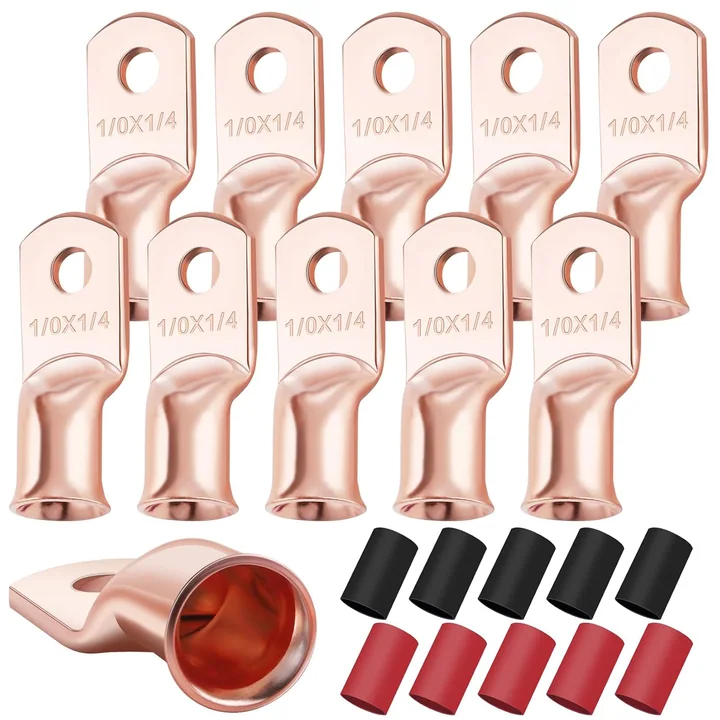
1/0 AWG Battery Cable Lugs with Heat Shrink
Copper ring lugs for 1/0 AWG battery cable, each pack with 3:1 heat shrink.$6.99 to $9.99per pack, by sizefrom $0.70 per piece
Covering the live terminals
A battery post or a stud that is always live can short against a dropped wrench or a loose cable. The rule asks for protection.
Each ungrounded terminal or stud that is continuously energized must meet § 183.455 or must have a boot, nipple, cap, cover, or shield that prevents accidental short-circuiting at the terminals or studs.
U.S. Coast Guard, Code of Federal Regulations, 33 CFR 183.445, Conductors: Protection (boat electrical systems). Read 28 September 2026.
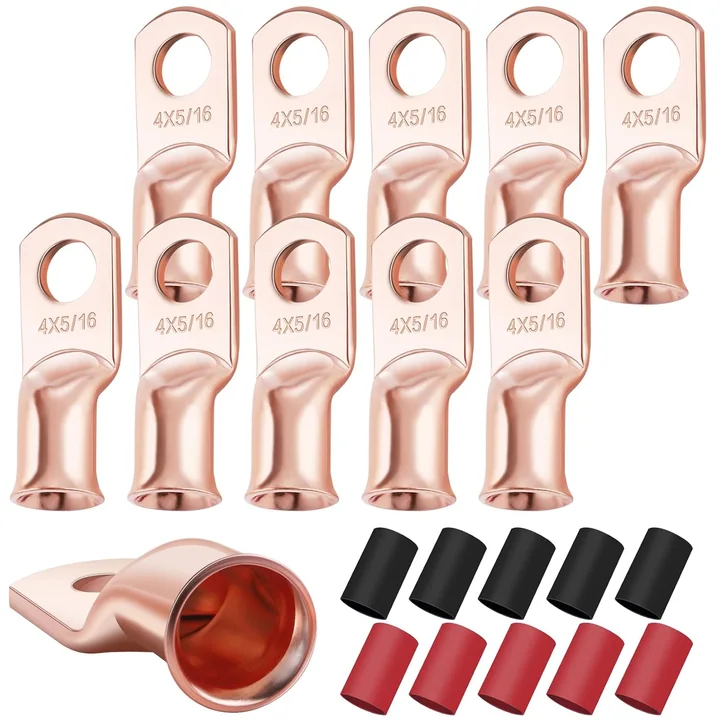
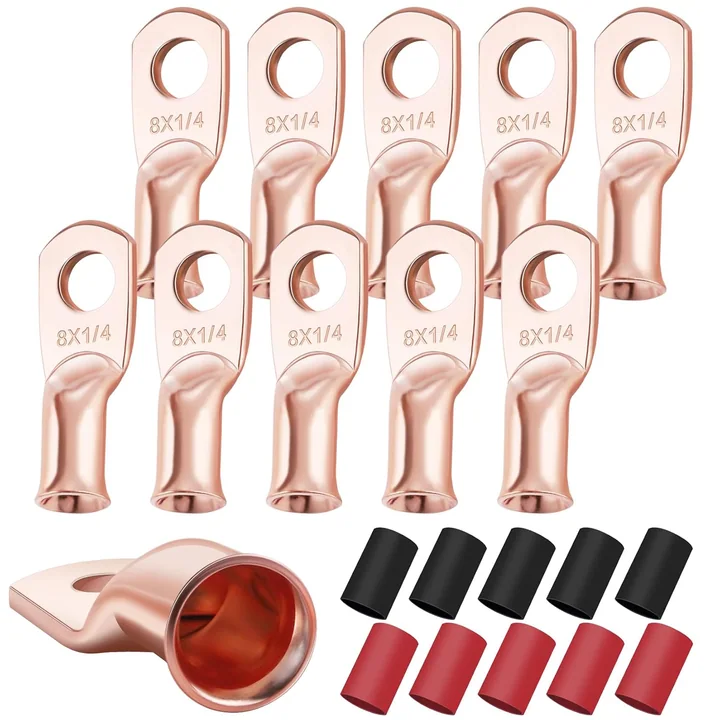
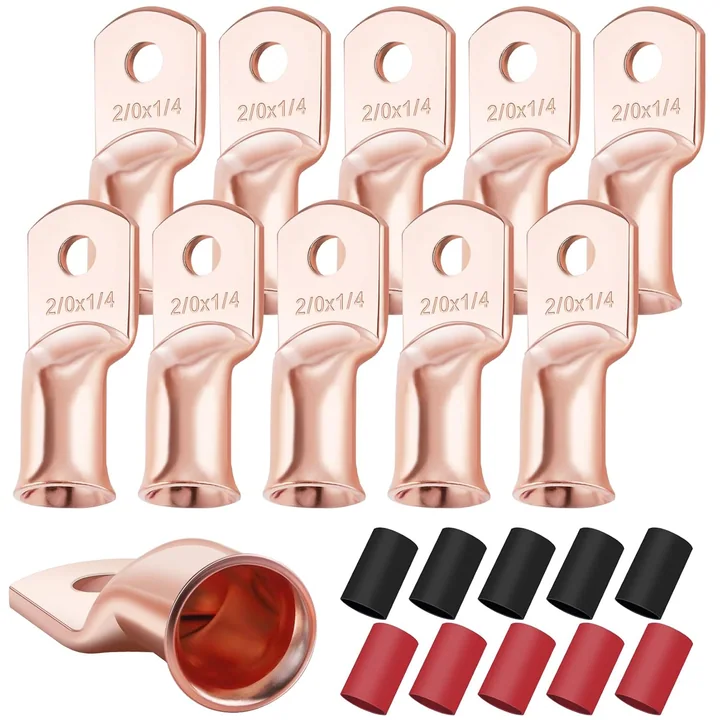
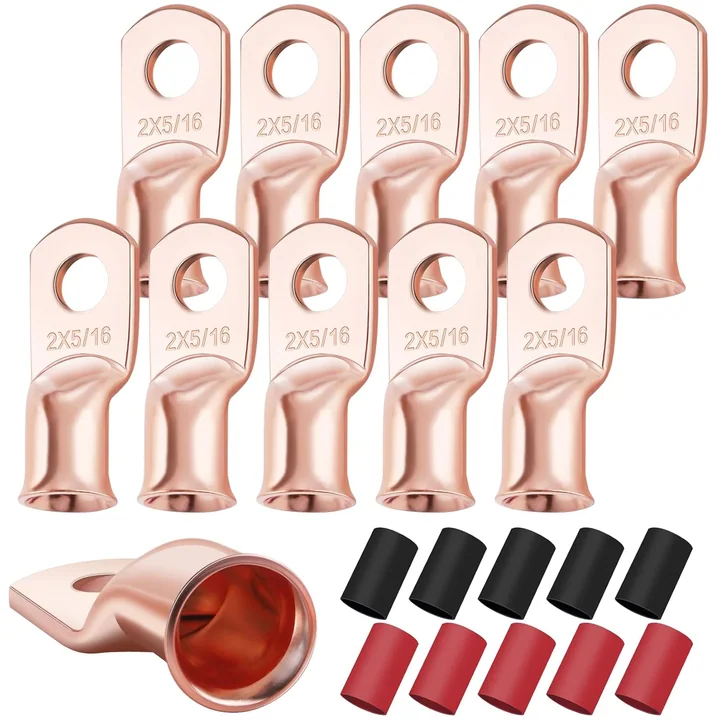
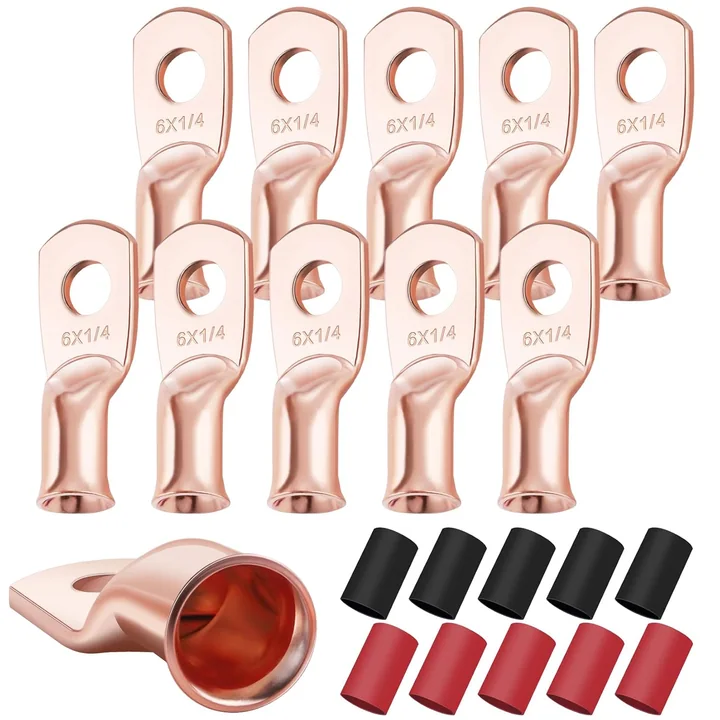
A boot or cover over the post is the usual answer. Heat shrink over the lug barrel is not a cover for the ring and the stud, but it seals the crimp, keeps water out of the cable and marks red from black. That is why every 10-pack of our battery lugs comes with five red and five black 3:1 sleeves.
- Battery Lugs
2 AWG Battery Cable Lugs with Heat Shrink
Copper ring lugs for 2 AWG battery cable, each pack with 3:1 heat shrink.$7.99 to $13.99per pack, by sizefrom $0.70 per piece
Choosing the lug
Size the lug by the cable, then by the stud. Most house batteries have 5/16 in or 3/8 in studs. Starter motors and bus bars vary, so measure. The table below lists every lug we make with the price per lug, worked out from the current packs.
| Cable | Studs we make | Pack sizes | Per lug, from |
|---|---|---|---|
| 8 AWG | 1/4 in, 5/16 in, 3/8 in, 1/2 in | 10, 20, 100 | $0.65 |
| 6 AWG | 1/4 in, 5/16 in, 3/8 in, 1/2 in | 10, 20, 100 | $0.65 |
| 4 AWG | 1/4 in, 5/16 in, 3/8 in, 1/2 in | 10, 20, 100 | $0.50 |
| 2 AWG | 5/16 in, 3/8 in, 1/2 in | 10, 20 | $0.70 |
| 1 AWG | 5/16 in, 3/8 in, 1/2 in | 10, 20 | $0.70 |
| 1/0 AWG | 1/4 in, 5/16 in, 3/8 in, 1/2 in | 10 | $0.70 |
| 2/0 AWG | 1/4 in, 5/16 in, 3/8 in, 1/2 in | 10 | $1.30 |
Where a cable passes through
The last rule is about the places a cable goes through something solid.
Each conductor or group of conductors that passes through a bulkhead, structural member, junction box, or other rigid surface must be protected from abrasion.
U.S. Coast Guard, Code of Federal Regulations, 33 CFR 183.445, Conductors: Protection (boat electrical systems). Read 28 September 2026.
A bulkhead edge or a hole in a box wears through insulation over a season of vibration. A grommet protects a hole in a bulkhead. Where a cable enters an enclosure, a cable gland protects it and seals the hole at the same time.
OSHA asks the same of boxes in workplaces on land.
Conductors entering cutout boxes, cabinets, or fittings shall be protected from abrasion, and openings through which conductors enter shall be effectively closed.
U.S. Occupational Safety and Health Administration, 29 CFR 1910.305, Wiring methods, components, and equipment for general use. Read 28 September 2026.
- Battery Lugs
6 AWG Battery Cable Lugs with Heat Shrink
Copper ring lugs for 6 AWG battery cable, each pack with 3:1 heat shrink.$6.79 to $69.99per pack, by sizefrom $0.65 per piece
A short checklist
- Stranded, tinned wire of the right gauge for the load.
- A lug that matches both the cable gauge and the stud.
- A crimp made with a tool sized for the cable.
- Glue-lined heat shrink over every crimp, red on positive and black on negative.
- A boot or cover on posts that stay live.
- A gland or grommet wherever a cable passes through something solid.
What this guide does not cover
Wire size for a given load, fuse ratings and battery switch placement depend on the circuit and are set out in tables we have not reproduced here. For those, read the full part 183 or ask a marine electrician.